
Modern Oedipus: A Cinematic Reading of Dune
“Free will is the modus operandi of destiny.”
— C.S. Lewis
As C.S. Lewis suggests, is free will truly the operative mechanism of fate? Is humankind genuinely free, or are our choices merely leading us toward an inevitable end? Throughout history, these questions have formed the foundation of countless works — from mythology to philosophy, from literature to cinema. Sophocles’ Oedipus, Shakespeare’s Hamlet, and Frank Herbert’s Paul Atreides — each is a tragic figure confronted by destiny, who, in attempting to resist it, ultimately engineers his own downfall.
In this essay, I will examine Dune and Dune: Messiah through the lens of the Oedipal tragedy, arguing why Paul Atreides may be regarded as a modern Oedipus. I will also briefly address his inner conflict in relation to Hamlet, as the two share striking psychological parallels.
The article you’re about to read may contain spoilers
regarding Dune, Dune Messiah (books), and the films
Dune (1984), Dune (2021), Dune: Part II (2024),
Hamlet (1990), The Matrix Revolutions (2003), and The Trial (1962).
Tragic Heroes: Oedipus, Hamlet, and Paul
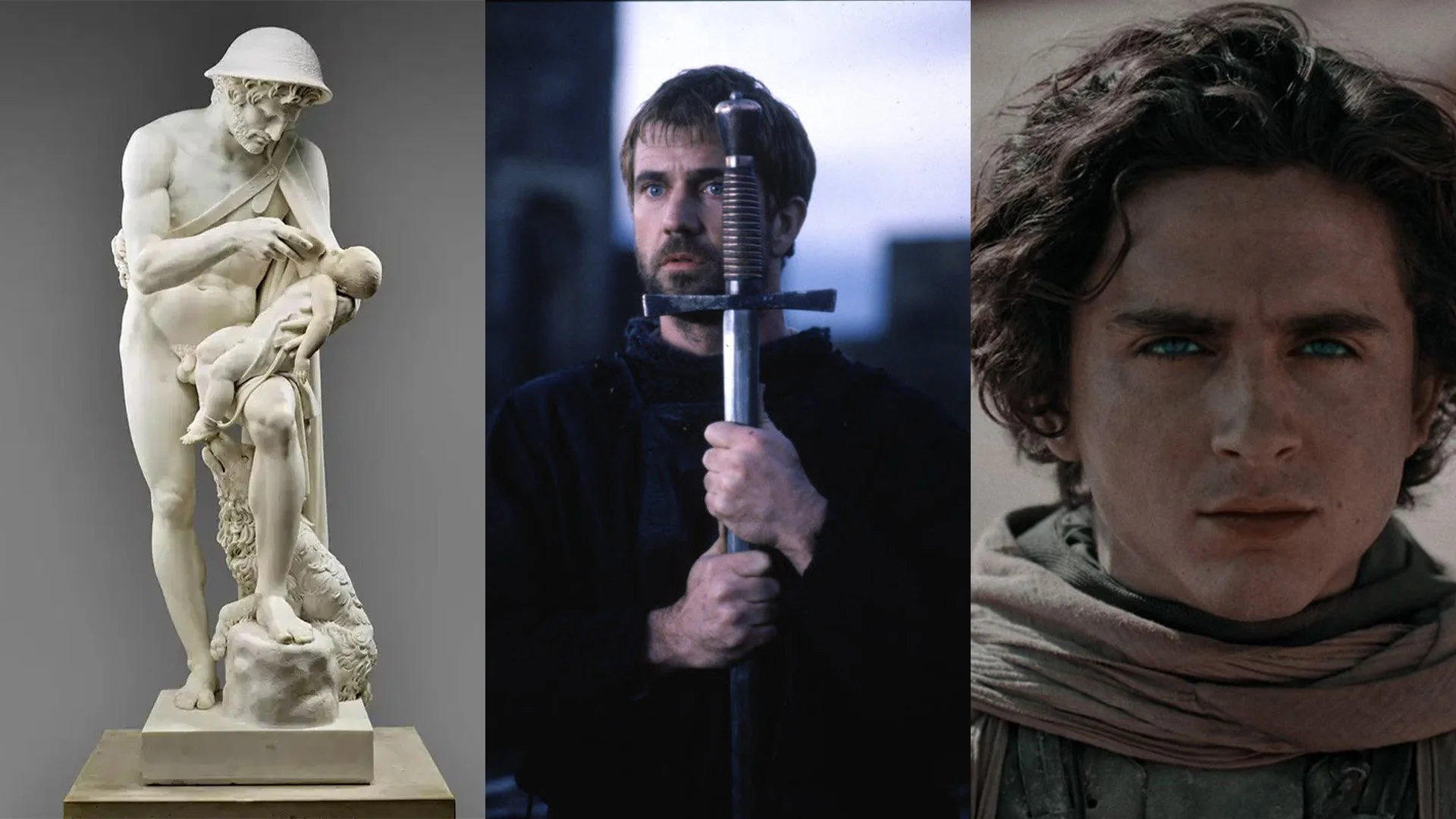
From left to right: The Child Oedipus Revived by the Shepherd Phorbas (19th century), Mel Gibson as Hamlet (1990), Timothée Chalamet as Paul Atreides (2024)
To establish this comparison, we must first lay out the defining characteristics of the tragic hero. In Poetics, Aristotle lists several key traits that distinguish the tragic protagonist:
Noble lineage — the hero is born into a royal, aristocratic, or otherwise distinguished family (kings, leaders, or warriors).
Possession of a tragic flaw (hamartia) — a fundamental error or shortcoming that ultimately leads to the hero’s downfall.
A reversal of fortune (peripeteia) — a turning point in which the hero’s actions produce unforeseen consequences, resulting in the loss of status or honor.
A moment of recognition (anagnorisis) — the realization of one’s own flaw or mistake, which usually comes too late to alter the course of fate.
The evocation of pity and fear leading to catharsis (catharsis) — tragedies, at their core, are moral narratives meant to elicit compassion and emotional purification in the audience.
Let us now consider how these characteristics align with the works of Sophocles and Herbert respectively. To begin, it would be useful to briefly recall the story of Oedipus for those who may not remember it in detail.
Aristotle, Poetics
2. The Fate of Oedipus: The Inevitability of Prophecy
King Oedipus of Thebes seeks to save his city from a devastating plague. Creon declares that the plague persists because the murderer of the former king, Laius, still resides within the city. Determined to find the killer, Oedipus begins his investigation — only to uncover a terrifying truth.
As an infant, Oedipus had been abandoned due to a prophecy foretelling that he would one day kill his father and marry his mother. Unaware of this prophecy, he was raised under the care of the king and queen of Corinth. In an attempt to escape this fate, Oedipus later left Corinth, killed a man along the road, and married the widowed queen of Thebes. Yet the man he killed was none other than his father, Laius, and the woman he married was Jocasta — his mother. When the truth is finally revealed, Jocasta hangs herself, and Oedipus, as both a symbolic act of punishment and an emblem of enlightenment, blinds himself and goes into exile.
Oedipus the King/Oedipus Rex, Sophocles
Sophocles’ Oedipus Rex masterfully explores the conflict between free will and fate — so profoundly, in fact, that it has been referenced and reinterpreted across countless works throughout history. For instance, in 1966, Jim Morrison — one of the greatest rock icons of all time — incorporated a passage about Oedipus into The End, a performance that got The Doors banned from the Whiskey a Go Go bar. Yet, that same performance was so striking that Elektra Records decided to sign the band and produce their debut album. Similarly, in the preface to the Turkish edition published by İş Bankası, Oedipus is described as “one of the foremost figures in the struggle against fatalism.”
Drawing upon both Aristotle’s Poetics and Sophocles’ Oedipus Rex, we can clearly see how Paul Atreides’ narrative arc constitutes that of a tragic hero.
Like Oedipus, Paul comes from a noble lineage. His tragic flaw (hamartia), however, originates from his mother, Lady Jessica, a member of the Bene Gesserit order — a secretive sisterhood that has manipulated a selective breeding program for millennia in pursuit of creating a male being capable of transcending space and time. This prophesied figure is known as the Kwisatz Haderach. Jessica, acting out of love and defiance, gives birth to this male heir one generation earlier than the Bene Gesserit had planned.
This, in essence, is Paul’s fundamental flaw as a tragic hero. Frank Herbert constructs a striking narrative dilemma here: the Fremen prophecy of the Lisan al-Gaib is not divine in nature, but rather one of the self-fulfilling prophecies planted by the Bene Gesserit on Arrakis. In this light, Paul’s ability of prescience — his capacity to perceive possible futures — is less a divine gift than a burden of fatal awareness. It binds him, forcing him to act (or refrain from acting) under the weight of visions that he simultaneously fears and fulfills. Thus, what appears to be a blessing becomes, in truth, the instrument of his tragedy.
Similarly, as both the book and the film reveal, Paul Atreides—like Oedipus—ultimately fulfills the very prophecy he seeks to escape. This, much like C.S. Lewis’s reflection on fate and free will, points to a profound dilemma at the heart of these narratives: the human struggle against forces that transcend their own understanding.
At its core, the stories of ancient Greek tragedy are moral allegories reminding humankind of moderation — that no one, regardless of power or nobility, can command every aspect of existence. Kings, dukes, or lords alike remain bound by the same limits of human frailty.
3. The Metaphor of Blindness: Oedipus and Paul’s Loss of Sight

The Matrix Revolutions (2003), directors: The Wachowskis
“They’ve blinded my body, but not my vision … I am in the world beyond this world here. For me, they are the same. I need no hand to guide me. I see every movement all around me. I see every expression of your face. I have no eyes, yet I see.”
Dune Messiah, Frank Herbert
The relationship between blindness and wisdom in Oedipus Rex reemerges in Dune, particularly in Dune: Messiah. When Oedipus learns that the prophecy has been fulfilled, he blinds himself in despair; likewise, toward the end of Dune: Messiah, Paul Atreides loses his physical sight—yet, despite his blindness, he becomes a tragic hero cursed with the ability to see everything. Both Oedipus and Paul attempt to escape prophecy, but such attempts inevitably lead them to the very fate they fear.
In both stories, the motif of blindness carries a symbolic and poetic subtext. Paul’s prophetic visions of the future were, in fact, illusions. His foresight—what he believed to be insight—was possibly nothing more than a mirage shaped by his own obsession. His faith in the inevitability of those visions led him to believe that his decisions were preserving humanity with minimal loss. Thus, both characters were deprived of true sight while their eyes still functioned; only through blindness were they able to see the truth. And yet, cursed by this very truth, they became blind.
At this point, one might argue that Oedipus, as a figure of Greek tragedy, is not so much a “character” as a type—since classical tragedy often functions through typology rather than psychological depth. Thus, the parallel between Hamlet and Paul becomes more pronounced; yet, it is worth noting that this essay approaches them through the framework of the tragic hero.
As for the connection between Hamlet and Paul: in an earlier essay I wrote on Hamlet, I discussed how classical tragedy lacks psychological dimension and instead foregrounds fatalité—the dominance of fate. Shakespeare’s Hamlet, however, can be regarded as the first truly modern character in this sense. Accordingly, Paul Atreides too qualifies as such, since both the novel and Villeneuve’s film vividly portray his internal and external psychological conflicts. For example, Paul initially perceives prophecy as a means of control—something designed to manipulate people—and therefore refuses to become part of it. Yet over time, the circumstances surrounding him reshape his inner conflict, compelling him to make different choices.
As a side note, another messianic figure, Neo in The Matrix Revolutions, also becomes blind. In that scene, Agent Smith mockingly addresses him as “the blind messiah.” Similarly, Neo’s blindness, much like Paul’s in Dune Messiah, serves as a metaphor for enlightenment—akin to Plato’s Allegory of the Cave, where the act of seeing the truth comes only after one leaves behind the shadows of illusion.
Like Hamlet, Paul is also a duke—and, much like Hamlet, he finds himself entangled in a chain of events triggered by his uncle’s betrayal and his father’s assassination. In short, for these and many similar reasons, the parallels between Paul and Hamlet become even more pronounced in terms of narrative arc. However, it is important to remember that the Renaissance, in an intellectual sense, was itself a return to antiquity.
Of course, Shakespeare broke Aristotle’s three unities (see Poetics), yet describing this as a total rupture can be somewhat excessive. The supposed divide between Antiquity and the Renaissance—and later, between the Renaissance and the Modern or Postmodern periods—is not as vast as it is often assumed to be. Indeed, the very existence of the Postmodern remains open to debate, though that discussion belongs elsewhere.
4. The Smallness of Man Before Nature: The Cinematography of a Tragedy

The Art and Soul of Dune, Tanya Lapointe
“THE DESERT INPIRES a deep sensation of isolation in one’s heart. It provokes inevitable introspection. Like a microscope, the desert magnifies our existential fears. Stripped down from any social construction, and in direct contact with the vertigo of the infinity of space and time, we are left naked. The desert brings us back hypnotically to our very own human condition. It induces joy, humility, melancholia, and sometimes a barren terror. That exact feeling of isolation is what sparked the inspiration for Dune’s production design.”
The Art and Soul of Dune, foreword by Denis Villeneuve
In the preface to this Dune artbook, Villeneuve’s remarks on isolation and human fragility before nature in fact define much of the film’s cinematography. While Dune is certainly not a film noir, it nevertheless evokes a similar sense of existential insignificance through its overwhelming sense of scale—much like Orson Welles’ adaptation of Kafka’s Le Procès (1962). With visuals that dwarf the human figure, the film accentuates humanity’s smallness and inadequacy. Herbert’s ecological world-building was precisely designed to achieve this effect: an entire planet made of desert, colossal sandworms towering over forty meters, and temperatures so extreme that survival without specialized suits becomes impossible.
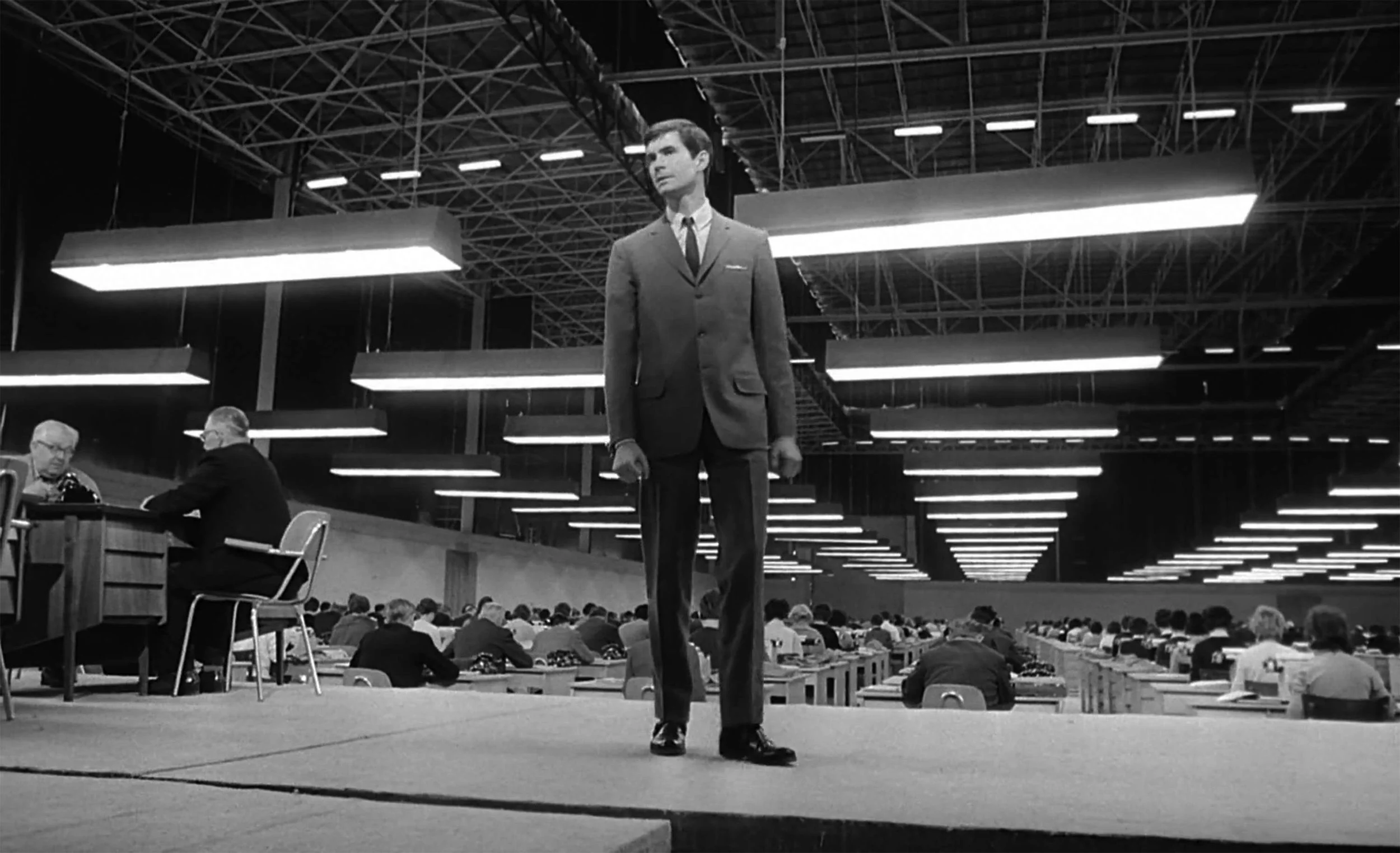
Le Procès (1962), director: Orson Welles
Reflecting this theme of human fragility against nature, Paul is depicted early in the film through wide-angle lenses that render him physically smaller. Within vast halls and expansive desert landscapes, he appears fragile and diminished, as if swallowed by his surroundings. For example, in the scene where Paul meets Reverend Mother Mohiam, he walks through long corridors and towering architecture—spaces intentionally constructed to evoke his vulnerability. Through this manipulation of scale and spatial design, the production design reinforces a fundamental visual thesis: the insignificance of man in the face of the universe.
As Paul Atreides meets Reverend Mother Mohiam
In Dune: Part II, the use of telephoto lenses and low-angle shots serves a deliberate narrative purpose: to make Paul appear larger, more commanding, and almost monumental. As his character arc progresses, we begin to see him framed in compositions that emphasize his dominance—his figure fills the frame, sometimes even exceeding its bounds, as if the image itself cannot contain him.
Likewise, this visual transformation parallels the sequence in which Paul drinks The Water of Life and undergoes a grotesque metamorphosis. His eyes, turned an intense shade of blue from excessive spice exposure, signify both his ascension and his curse—the expansion of his prescience, his ability to perceive the future. At this point, Paul’s tragic downfall begins: convinced that the path he chooses is the only one that can lead to salvation with minimal loss, he steps fully into the role of the doomed messiah.
As the Emperor and Baron descend upon Arrakis, Paul unleashes the atomics — a turning point that seals his destiny.
“I wrote the Dune series because I had this idea that charismatic leaders ought to come with a warning label on their forehead: ‘May be dangerous to your health.’ “
Frank Herbert, 1979
Everything we have discussed so far aligns closely with Herbert’s original vision in writing Dune, because—as Denis Villeneuve frequently emphasizes—Herbert himself described the story of Paul Atreides as a warning. It is, in essence, a cautionary tale about the corruptive potential of power, even when attained for entirely valid and righteous reasons. A leader who rises to absolute authority is always at risk of becoming a despot. Unfortunately, readers of Herbert’s time largely misunderstood this intention, perceiving Paul Atreides as a conventional hero. This misconception perhaps stems from the novel’s narrative structure, which unfolds gradually and reveals its meaning layer by layer.
By contrast, The Lord of the Rings presents a clear moral trajectory: no matter how complex its mythology, the reader never loses sight of the central motif—the ring must be destroyed. Dune, however, offers no such clarity. The story begins amidst political turmoil, following Paul Atreides’ coming-of-age journey and his exile after his father’s assassination. What follows is a dense web of political conflict, set on an alien planet with an unfamiliar religious syncretism of Zensunni thought. Consequently, Dune has often been misinterpreted for precisely this reason. It was to address this misunderstanding that Frank Herbert wrote Dune Messiah as a sequel.
Villeneuve, in numerous interviews, has stressed that his adaptation of Dune was designed in accordance with Herbert’s philosophical vision. For that reason, it is not difficult to anticipate where Dune: Messiah—expected to release in 2026—might lead us.
The ecological themes of Dune further reinforce its allegorical dimensions. Herbert constructed Arrakis with a fragility that mirrors our own planet, and in this sense, one can clearly speak of a Middle Eastern allegory.
In summary, we have called Dune a modern Oedipus. Despite his prescience and noble lineage, Paul Atreides is—like Oedipus—ultimately too small to defy his fate. Villeneuve’s film demonstrates this through both its cinematography and production design: the endless desert reminds us of humanity’s insignificance before nature.
So, what do you think about this film or these books? Is Paul a tragic hero—or simply a villain? More importantly, how do you interpret Dune’s message in today’s world? Let’s discuss it in the comments.
