
Discourses on J.R.R. Tolkien’s Middle-earth

illustration: John Howe, 1989
On What the One Ring Represents
“One Ring to rule them all, One Ring to find them,
One Ring to bring them all, and in the darkness bind them
In the Land of Mordor where the Shadows lie.”
I assume that nearly everyone recognizes the corruption brought about by the One Ring in The Lord of the Rings—its power and the way it distorts the one who wields it. Yet what kind of corruption is this, and what kind of power are we speaking of? To understand this, we need to investigate the origin of that power. It is a force so immense that it ultimately determines the fate of the entire world.
Considering Tolkien’s expertise in Greek philology, the parallel between the function of the Ring of Gyges narrated in Plato’s Republic and the One Ring forged by Sauron in Mount Doom is striking. In the text, after Socrates and Thrasymachus discuss the concepts of the just and the unjust, Glaucon joins the conversation and recounts this myth. According to the myth in question, Gyges was a shepherd in the service of the Lydian king when, while wandering among the ruins caused by an earthquake and a flood, he saw a golden ring on the finger of a corpse and took it — the fact that the ring is golden in both works clearly emphasizes human greed. At the monthly assembly held before the king, Gyges attended with this ring on his finger, and during the gathering, when he turned the ring, he realized that he had become invisible. Thereupon, he entered the palace, seduced the queen, slept with her, killed the king, and took his place.
Ultimately, Glaucon draws the following conclusion: “This example shows that human beings act justly not by their own will, but by compulsion.” In response, Socrates initially emphasizes that he “does not yet know” how to defend the just, and then, believing that the just will triumph in the end, they undertake the attempt to construct a state from scratch. At this point, it is entirely reasonable to interpret the Ring in Tolkien’s universe as representing the unjust.

Depiction of Gyges Discovering the Ring, 16th Century
In this context, the story of the Ring of Gyges shows us the following: morality is a phenomenon formed within a social framework, and a person will abandon their moral values the moment they know they will remain hidden. A person will choose to be just only if they fear a certain punishment or being watched (see: the Lidless Eye, Sauron’s Eye). However, Socrates, in the continuation of this discussion, proposes that the just and the unjust are absolute and definite and are known (because earlier, Glaucon had argued that the final degree of the unjust is to appear just without being so), and he states that the person who wishes to use Gyges’ ring in accordance with their desires and ambitions will become a slave to these low and base desires and will ultimately be ruined. We can see this state of being enslaved to such low and base desires very clearly in the character of Gollum. The Ring causes a split personality in Gollum and creates a plainly visible deformation. He personifies the Ring and addresses it as “my precious.” On the other hand, Socrates argues that the one who lives justly and morally will have a controlled, meaningful, and happy life. For example, Tom Bombadil does what is just by not being deceived by the Ring.
In another context, I see no issue in saying that the Ring holds the one who bears it captive like a shackle (or at least evokes such captivity), and that this is the reason why the symbol of the ring is used, and even that it represents Tolkien’s conception of world history not as linear, but as cyclical. I will return to this later. Additionally, if the Ring is the unjust, in a Christian context it is important to note that it is not simply the opposite of the just, but something that has been corrupted afterward, an addition. It is not possible to think of a correlation between the existence of the Ring and the existence of the human being. I will explain this in “Middle-earth in the Context of Tolkien’s Catholic Perspective.”
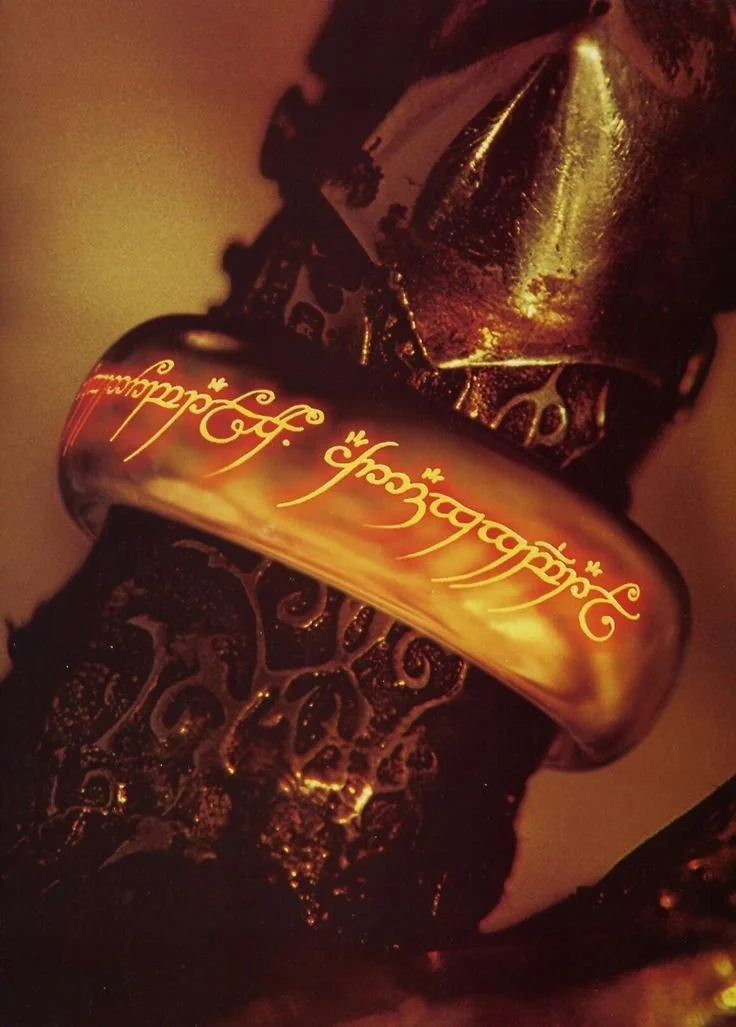
The One Ring with glowing inscription on Sauron’s gauntlet.
On the other hand, we cannot attribute merely the notion of “power” to the Ring; this would be an ambiguous designation. Indeed, it frequently appears in the context of dominion (iktidar). And as with every form of dominion, this dominion, too, will have its flatterers; and in fact, the imitations of this dominion by Gollum or Saruman stem not from the desire simply to seize the Ring, but from submitting to its majesty and choosing to live in accordance with its will. In Tolkien’s work, those who submit to the will of the Ring, much like in what Socrates says, become enslaved to low and base desires, and this desire to possess appears in many Middle-earth mythologies. For instance, in The Hobbit, Smaug, a dragon, sleeping amidst the gold, in one sense reflects Thorin’s greed for gold. Just as a dragon should have nothing to do with gold, so too a human (or a dwarf) should not. Another example is that of the people who cannot accept their mortality and, for the sake of immortality, begin to worship Melkor (Morgoth).
“Human stories are practically always about one thing, aren’t they? Death. The inevitability of death.”
— Tolkien in Oxford (BBC2, 1968)
In the end, we must see that this discussion, which forms the starting point of Plato’s utopia, has a similar counterpart in Tolkien’s Middle-earth, and that Tolkien ultimately brings this discussion back to the table. Does being just bring good things in the end? The way to create a good world is not to appear just without being just, but to choose the just and to live with the just. Indeed, this has been the only thing that resisted the endurance of the Ring, and with the destruction of the Ring, the Third Age of the Sun comes to an end.
“There is one proviso: if there is any satire present in the tale, one thing must not be made fun of, the magic itself. That must in that story be taken seriously, neither laughed at nor explained away. Of this seriousness the medieval Sir Gawain and the Green Knight is an admirable example.”
On Fairy‑Stories, by J.R.R. Tolkien, p. 4.
Middle-earth in the Context of Tolkien’s Catholic Perspective

J.R.R. Tolkien's Ainulindalë, comics by Evan Palmer
“In the beginning was the Word, and the Word was with God, and the Word was God.
The same was in the beginning with God.
All things were made by him; and without him was not any thing made that was made.”
John 1:1–3 (KJV)
Although Tolkien described himself as religious, and although we occasionally encounter Christian references and symbolism in his body of work known as the legendarium, this does not occupy an excessively central place for him. Indeed, what truly mattered was to establish—in his own words—a genuine mythology and epic tradition within English Literature, which he believed to consist of merely a few scattered poems.
Nevertheless, when we look at the creation of Middle-earth, at the events preceding the beginning of the count of time, and at the overall history of Middle-earth, we can clearly see a strongly Christian (biblical) perspective in the clash between good and evil (and some may call this light and darkness). We can see the influence of Tolkien’s Catholicism quite distinctly. For example, the creation of the Ainur (the Holy Ones) by Eru Ilúvatar through music is notable. In Tolkien’s works, the importance of music, speech, and the word recalls that of the Bible.
“There was Eru, the One, who in Arda is called Ilúvatar; and he made first the Ainur, the Holy Ones, that were the offspring of his thought, and they were with him before aught else was made. And he spoke to them, propounding to them themes of music; and they sang before him, and he was glad.”
J.R.R. Tolkien, The Silmarillion — Ainulindalë
Melkor, who later desired to rule over the World that had been created through the music of the Ainur, resembles the fallen angel (Lucifer) of the Bible. With the arrival of the Elves, Melkor’s imprisonment in the Halls of Mandos; and moreover, the fact that Melkor did not create evil on his own, but corrupted what Eru had created, are significant references. For in Christianity, the distinction between good and evil is of this kind. Evil does not appear before us as something purely evil; rather, it is understood as something fallen good. Indeed, in the beginning, neither Melkor nor what he “created” were evil. For example, Melkor “created” the Orc race by torturing Elves. The corruption of Arda takes place precisely in this way. That Sauron — who would later take the diabolic title from Melkor — is himself a shapeshifting Maiar, and that his form corresponds to the Biblical description of the demon as a “seven-headed, ten-horned, red dragon,” is striking.
“Nothing is evil in the beginning. Even Sauron was not so.”
— J.R.R. Tolkien, The Lord of the Rings: The Fellowship of the Ring,
Book II, Chapter 2: The Council of Elrond
The evil we encounter in Tolkien’s works arises from an insatiable desire to acquire, to rule, and to dominate. And I am of the view that this evil, too, has no divine origin; it exists as an addition, just like the Ring itself.
At the same time, the idea—present in Christianity—that humanity would lose its way without the help of God appears frequently throughout Middle-earth. Throughout the Lord of the Rings, various characters, as if drawn together, step in to guide and assist Frodo. Although their paths sometimes diverge (cf. Fellowship of the Ring), Frodo ultimately requires constant guidance on this difficult journey, and that need is always met. Most notably, Samwise Gamgee never leaves his side—not even for a moment. Another example is when Galadriel, in the Fellowship of the Ring, gives Frodo the Phial filled with the light of Eärendil’s Star, which later helps Frodo and Sam find their way in Cirith Ungol.
“…free will is the modus operandi of destiny.”
C.S. Lewis, Of Other Worlds: Essays and Stories
modus operandi (Latin): its manner of working; the principle by which something operates
In The Lord of the Rings, Frodo cannot be regarded as a messianic figure in a strictly Judeo-Christian sense. In particular, his moment of hesitation and lack of will when the Ring must finally be destroyed immediately disproves such an interpretation. In fact, what is emphasized is precisely this. In accordance with the Christian notion that “God works in mysterious ways,” and the earlier idea that humanity would be lost without God’s guidance, the destruction of the Ring requires the convergence of the wills of countless different characters. In The Fellowship of the Ring, Gandalf speaks of this when he says: “My heart tells me that before the end, he [Gollum] will play some part yet, for good or ill before the end…”
Yet the Ring could not have been borne by anyone other than Frodo. For he was, as Gandalf understood, in a sense chosen—and he affirms this through the mercy he shows to Gollum at a moment when no one else (not even Sam) is capable of doing so.
On the other hand, there is a motif in Christianity that does not quite appear in other religions: God (Christ) sacrifices Himself for the sake of humankind. In a curious way, Frodo’s journey mirrors this; even the act of bearing the Ring—its weight pressing upon him—creates an effect akin to Christ carrying the cross.
“Many that live deserve death. And some that die deserve life. Can you give it to them? Then do not be too eager to deal out death in judgement. For even the very wise cannot see all ends.”
― J. R. R. Tolkien, The Fellowship of the Ring (Book I, Chapter 2: The Shadow of the Past)
In this context, throughout Tolkien’s legendarium we witness certain characters being brought back to life, while others meet ‘unexpected’ deaths. The importance of oaths in Christianity is likewise emphasized frequently in Tolkien’s works. Once an oath is broken, the arrival of a curse becomes inevitable. For instance, Boromir—who brings discord into the Fellowship that has embarked on a sacred quest—will die before the Fellowship is fully broken, regardless of whether he is essentially good or not. Saruman, similarly, suffers a bitter end as the price for no longer being the Maiar he was meant to be. Conversely, in accordance with a Christian motif, those who act selflessly and place others before themselves are sometimes returned to life after their seemingly unexpected deaths. For example, after his battle with the Balrog, Grey Gandalf is returned to life as White Gandalf; or consider Beren, a mortal man, who dies after stealing a Silmaril from Morgoth’s Iron Crown, and Lúthien, the immortal Elf who loved him, dies as well from the grief of losing him. The two are then granted life again.
“The LORD kills and brings to life;
he brings down to Sheol and raises up.”
— 1 Samuel 2:6 (ESV)
On The Hobbit and Middle-earth as Allegory
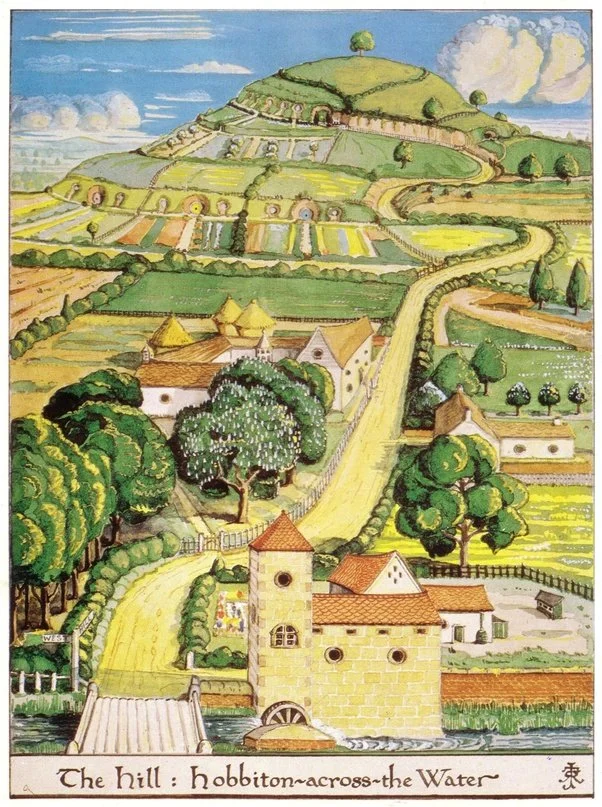
The Hill: Hobbiton Across The Water Original Art (1937) by J. R. R. Tolkien
“All great literature is one of two stories; a man goes on a journey or a stranger comes to town.”
— commonly attributed to Leo Tolstoy
(source uncertain)
Tolkien firmly rejected the question of whether The Lord of the Rings should be understood as an allegory; yet the term “allegory” itself, or rather the meaning it carried in his time, was more restrictive than the broader, layered sense we might ascribe to it today. For this reason, it is not surprising that Tolkien disliked the word in many contexts. Still, as we have already noted, there is a narrative mode in his works that resembles Plato’s double sens (dual meaning). Moreover, Tolkien describes The Lord of the Rings in the same interview as follows:
“But that seems, I suppose, more like an allegory of the human race. I've always been impressed that we're here surviving because of the indomitable courage of quite small people against impossible odds: jungles, volcanoes, wild beasts... they struggle on, almost blindly in a way.”
— J.R.R. Tolkien, interview with Dennis Gerrolt, BBC Radio 4, 1971
At this point, it is clear that Tolkien had a problem not only with the word allegory itself, but also with the connotations it carried (and indeed, he emphasized that what exists in the work is rather a moral). Yet the issue he insists upon here is crucial; for although Tolkien had, directly or indirectly, his own dispute with both World Wars, in his works he treats human history as a continuously recurring cycle, and if there is an allegory to be found at all, it amounts to no more than this. For instance, equating the Uruk-hai in The Lord of the Rings with SS officers, or Saruman’s White Hand with the Swastika, does not signify anything within the historical framework of Middle-earth. In fact, precisely because most people would be inclined to derive such parallels from the word allegory, Tolkien deliberately distanced himself from it. And yet, paradoxically, the very meaning he wished to convey is still best captured only by this word.
In the end, Tolkien’s conflict with war is deeply dramatic: he fought in the Battle of the Somme in France as part of the Lancashire Fusiliers during the First World War, lost his close friends from the semi-secret society known as the T.C.B.S., and later, during the Second World War, feared losing his son Christopher—who had joined the Air Force at the age of eighteen and whom Tolkien referred to as “my chief critic and assistant.” Although he tried to deny the effect of war on his writing, Janet B. Croft demonstrates in War and the Works of J.R.R. Tolkien just how closely the theme of war in his works is tied to his own life. For instance, Tolkien, who often complained about the “discomfort” of wartime conditions, evokes the suddenness and unpreparedness of war—and how small and comical we can be in the face of it—through Bilbo’s line, “I’ve forgotten my handkerchief,” as he sets off on his adventure. He also mentions a comment made by his close friend C. S. Lewis about The Hobbit, noting that “hobbits are only amusing when in unhobbitlike situations.”
“In peace, sons bury their fathers; in war, fathers bury their sons.”
— Herodotus, The Histories, Book I, section 87
There have been numerous readings of Tolkien’s The Hobbit, published in 1937, through Joseph Campbell’s theory of The Hero’s Journey. For this reason, rather than examining all twelve stages of Campbell’s model one by one, it is more useful to show how certain stages of the theory align closely with what Tolkien calls the “allegory of humanity.” The first three stages of Campbell’s model are named as follows: Ordinary World, Call to Adventure, and Refusal of the Call.

Joseph Campbell’s Hero’s Journey diagram
The Shire—much like Middle-earth itself—is isolated and indifferent to the rest of the world; or, in Tolkien’s own words: “Hobbits are just rustic English people, made small in size because it reflects (in general) the small reach of their imagination - not the small reach of their courage or latent power.” Middle-earth, the Shire, and the Hobbits form a layered structure that resembles a matryoshka, each nested within the other and each echoing the same meaning. Middle-earth also belongs within this “allegory of humanity,” for it is surrounded by oceans and inhabited by the races cast into the world by the Music of the Ainur, and its history unfolds through a continuous cycle of repetition. Much like the ironic phrase “War is Peace” in George Orwell’s 1984, Middle-earth’s history—like that of our own world—repeats itself, as though trying to restore balance to a perpetually tilting scale. This is not only true in the political sense, but in many other ways as well. For instance, the love of Beren and Lúthien strongly resembles that of Aragorn and Arwen. And although the Ring in the Riddles in the Dark chapter appears, at first, to carry little thematic weight, it later emerges—along with the broadening of Middle-earth’s history—as a symbol of power, dominion, and ultimately the corruption born from humanity’s insatiable desire to possess and to rule.
Returning to Campbell’s framework: the Shire represents humanity’s comfort zone. And in the face of the vastness of an unknown and uncharted world, the Hobbits must necessarily stand in for humanity itself, small in comparison to what surrounds them. For the world as the Hobbits perceive it is ordinary and as it ought to be; therefore, at the moment of the Call to Adventure, Bilbo Baggins refuses to leave his comfort zone—just as the “chosen” figures of many mythic narratives initially refuse the call. Only later, through the discovery of the outside world and the allure of the unknown, does the protagonist take on this responsibility and embark on the journey (cf. Plato’s Allegory of the Cave). After various hardships, ordeals, trials, and the eventual experience of resurrection, the character completes the adventure and returns home. And upon returning, he is no longer the same person.
“The world outside has not become less real because the prisoner cannot see it.”
— J.R.R. Tolkien, On Fairy‑Stories
What is emphasized here first is that these small beings possess the will to endure and to change far more than one might expect—and in this sense, the frequent emphasis on the concept of hope (estel) throughout Tolkien’s legendarium becomes meaningful. A person must first choose. Bilbo Baggins has already decided that he must leave Shire; all he needs is a mentor (Gandalf), and once the necessary nudge is given (once he realizes what his choice truly is), he will run out of the Shire without hesitation.
On the other hand, throughout The Lord of the Rings, against the dark atmosphere and the despair brought on by a war that spreads across nearly all of Middle-earth, the persistent and repeated emphasis on hope suggests that humanity—struggling within evil and resisting an evil of seemingly unmanageable scale—can change everything simply through the act of resisting itself. And indeed, it has. Just as in Bilbo’s adventure.
Frodo: I can't do this, Sam.
Sam: I know. It's all wrong. By rights we shouldn't even be here. But we are. It's like in the great stories, Mr. Frodo. The ones that really mattered. Full of darkness and danger, they were. And sometimes you didn't want to know the end. Because how could the end be happy? How could the world go back to the way it was when so much bad had happened? But in the end, it's only a passing thing, this shadow. Even darkness must pass. A new day will come. And when the sun shines it will shine out the clearer. Those were the stories that stayed with you. That meant something, even if you were too small to understand why. But I think, Mr. Frodo, I do understand. I know now. Folk in those stories had lots of chances of turning back, only they didn't. They kept going. Because they were holding on to something.
Frodo: What are we holding onto, Sam?
Sam: That there's some good in this world, Mr. Frodo... and it's worth fighting for.
The Lord of the Rings: The Two Towers (2002)
Bibliography / Sources
Carpenter, Humphrey (ed.). The Letters of J.R.R. Tolkien. London: George Allen & Unwin, p. 17, p. 140, p. 47.
Plato. The Republic. Book II, 359d; 360c; 361b. (Stephanus pagination.)
Tolkien, J.R.R. Of the Rings of Power and the Third Age. In The Silmarillion. London: George Allen & Unwin, p. 48.
BBC Two Documentary. Tolkien in Oxford. (1968).
Tolkien, J.R.R. On Fairy-Stories. (Originally 1939 lecture; published in Tree and Leaf.) p. 4; p. 20.
The Bible. Gospel of John 1:3.
The Bible. Book of Revelation 12:3.
The Bible. 1 Samuel 2:6.
Gerrolt, Dennis. BBC Radio 4 Interview with J.R.R. Tolkien (1971).
Tolkien, J.R.R. “Letter to Milton Waldman” (1951). In The Letters of J.R.R. Tolkien. (Carpenter, ed.)
Tolkien, J.R.R. The Silmarillion, “Ainulindalë (The Music of the Ainur)”. p. 47.
Tolkien, J.R.R. The Lord of the Rings: The Fellowship of the Ring, “The Council of Elrond”; “The Shadow of the Past”.
Tolkien, J.R.R. The Lord of the Rings: The Two Towers, “The Taming of Sméagol”.
Tolkien, J.R.R. The Silmarillion, “Quenta Silmarillion – Of Beren and Lúthien”.
Lewis, C.S. Of Other Worlds: Essays and Stories. p. 15.
Levin, Christoffer. The Hero’s Journey in J.R.R. Tolkien’s The Hobbit, or, There and Back Again.
Peter Jackson (dir.) The Lord of the Rings: The Two Towers. New Line Cinema, 2002.
